Showing posts with label Email Support. Show all posts

Tuesday, August 25, 2009

How to Embed a URL or HTML in an E-mail

Email has been used since well before the Internet started to see widespread public use in the late 1990s. In the past decade, email support clients have grown to support HTML (Hyper Text Markup Language)-formatted email in addition to the traditional text-formatted email. The use of HTML and URLs (Uniform Resource Locators) in the context of email creates a richer user experience by using imagery and references to support material to be received by friends, family and consumers. No special software has to be bought or downloaded in order to use HTML or URLs in the body of an email with most email services. From web client-based emails such as Google's Gmail to Microsoft's email client program, Outlook, HTML format can be selected for use for both sending and receiving email.

Step 1 : Log into your Gmail account and select the "Compose Mail" menu option.

Step 2 : Verify the email encoding setting that is beneath the attachment menu button. If the words "Rich Formatting" are visible, select the "Rich Formatting" menu option to enable HTML in the email.

Step 3 : Type a phrase in the email body in order to embed a URL. In this example, the words "My favorite internet acade website is iYogi.net" are input in the email body.

Step 4 : Screen shot of embedding a URL in Gmail

Create a URL by highlighting the spiderman-arcade.com words in the email, then selecting the hyperlink button in the formatting toolbar. The hyperlink button is the picture of a link of chain in the middle of the email format toolbar located just above the body of the email. Type the spiderman-arcade URL into the dialogue box which appears: "http://www.iyogi.net".

Step 5 : Type your email address in the email "To:" line and click the "Send" menu button.

Thursday, August 20, 2009

Get Rid of E-mail Spam

Unsolicited junk e-mail, or spam, is an unwelcome and often offensive byproduct of the Internet's success. Although there's no guarantee you can avoid all spam, there are ways to avoid looking at most of it.

Step 1 : If you're already getting spam messages, check with your Internet service provider to see whether it has a spam-prevention option that scans your incoming e-mail for known spammers.

Step 2 : If you're lucky enough not to be getting spam now, then sign up for a second (free) e-mail address from a service such as Yahoo or Hotmail. Use this address exclusively for e-commerce, mailing-list subscriptions and bulletin-board postings of any kind. Reserve your main e-mail address for private e-mail to and from friends.

Rule filtering

Step 1 : Setup email folder called Suspected Spam.

Step 2 : Use the filtering feature in your e-mail program to create rules that redirect spam messages to your Suspected Spam folder. Most spam is not addressed to its recipient by name.

Step 3 : Define a rule for incoming mail that says, "If my name appears in the To: or cc: field, then move this message to the Inbox." The procedure for defining rules varies among e-mail programs, so you should consult your program's Help feature to learn exactly how this works.

Step 4 : Define individual rules to catch e-mail that isn't addressed to you personally but that you nevertheless want to receive, such as messages from lists you've subscribed to. Have these rules redirect the relevant messages to the Inbox or to special folders that you have created for mail from those sources--for instance: "If the Sender field includes 'MyList,' then send this message to the MyList folder."

Step 5 : Define a final rule that sends all other e-mail that hasn't already been redirected by one of your other rules to the Suspected Spam box. For instance, a rule that says, "If the Sender field isn't 'XYXYXYXYY,' then move this message to the Suspected Spam folder" would work as a catchall.

Wednesday, August 19, 2009

5 Ways to Avoid Your Email Being "Hacked"

Twitter, media darling that it is right now, is logging a bit of bad press for having company documents stolen.

The short version is a hacker got into an employee's web email account, and from there was able to access information stored in Twitter's Google Apps account.

Depending on where you read the story, the spin is:

Twitter has serious security issues (partially true)

Cloud computing is unsafe (mostly false)

Someone needs a better password (clearly true)

The real lesson to be learned here is be extremely cautious with your email. Think about it. Virtually everything online is linked to your email account.

Are you equally vulnerable?

All of us keep both personal and company information online, ranging from mundane Facebook postings to critical financial access, such as bank or Paypal logins. Many of these sites are very secure in and of themselves, but access to an email account can bring all the dominoes tumbling down.

Is login info to other sites sitting in an email you sent or received? Are the passwords to more secure sites the same as your email account? Could a hacker reset the passwords to other sites with access to your email?

A compromised email account can be the backdoor to information a hacker couldn't get at any other way.

How not to fall into the Twitter trap (or is that twap?)

  1. Put a strong password on your email and webmail accounts.
  2. Be cautious in what you link to a webmail account with a major provider (Gmail, Hotmail, Yahoo, etc.). These are not inherently unsafe, but they are big targets.
  3. Never email login credentials to co-workers or vendors. You don't want that info residing in your (or their) email account.
  4. Have unique passwords for secure sites. Never reuse your email password.
  5. Change your passwords regularly. I know remembering all of them is a major headache, but strong passwords written on a piece of paper in a locked desk drawer are more secure than the same password on every site.

Tuesday, August 18, 2009

Signature on Windows Live Mail?

email support
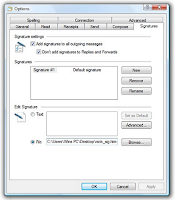
Many of us want to have a picture as Signature on windows live mail like a bmp or a text specifying our identity and other professional details. The steps below try to elaborate on the same about how to do that.

Go to Options on the Right Hand Side of your Windows Live Home Page and click on it.

In Windows Option Box
* You will get an option - 'More Options'. Click on it.
* Windows Live Option window will be displayed.
In the left hand side, there are option preferences - General, Mail, Spaces and Permissions.
# Click on 'Mail'

Windows Live Mail Customize Email OptionUnder 'Customize Your Mail', click 'Personal Email Signature'

* A Signature Editing Box will be displayed.
* Enter your desired signature and click Save.
* You are now ready with your personal Windows Live Email Signature.

Thursday, August 13, 2009

How to Recover Password in AOL


Step 1 : Open a Web browser and go to the Web mail page where your email is stored. AOL or Gmail are examples of a Web mail site, but many ISPs also provide Web mail in addition to email access through an email client such as Outlook Express.

Step 2 : Click on the "Forgot Password" link just under the "E-mail" or "Screen Name" and "Password" fields on the AOL sign-in screen (using AOL as a specific example).

Step 3 : Enter your email or "Screen Name" in the field provided when you reach the "Password Reset" screen.

Step 4 : Enter the "Captcha" numerals and letters exactly as they are presented to you in the field provided and click "Next." (Captcha is a security feature designed to reduce automated spammers from exploiting the system.)

Step 5 : Enter your birth date, gender and ZIP code in the second "Password Reset" screen and click "Next."

Step 6 : Click "Continue" at the "Password Reset: E-mail Sent" screen. You will see the message that informs you, "An email has been sent to the alternate email address you provided when registering this account."

Step 7 : Collect the email sent to you from AOL at your alternative account and click on the link provided to enter a new password for your email account.

Step 8 : Change the password in your email client to be able to collect your email using this method, if applicable.

Wednesday, August 12, 2009

How to change a hotmail password?

fix email problem
Step 1 : Sign in to your Hotmail account. Regardless of whether your home screen is your inbox or Windows Live's "Today" screen, in the upper right corner, just under your name, you will see a tab that says "Options" with an arrow next to it. Click that. It will open a drop-down menu that includes the choice of "More options."

Step 2 : Choose "More Options." In the "Hotmail Options" screen that appears, choose "View and edit your personal information" under "Manage your account."

Step 3 : Go to the section that reads "Password Reset Information." You will see "Password: ********" and next to it a blue hyperlink that says "Change." Click the hyperlink.

Step 4 : Enter your old password, then your new password. You'll be asked to enter this twice.

Step 5 : Click "Save." You'll be taken back to the "Manage your account" screen, which will now have a blue box at the top reading "your information has been saved."

Wednesday, November 12, 2008

How to back up .pst file data that is located on a Microsoft Exchange Server

To know how to back up your data if you use Outlook with a Microsoft Exchange Server, you have to know where the data is stored. The default delivery and storage location for Outlook data is the Exchange Server mailbox. The Exchange Server administrator usually handles backups of the mailboxes on the server. However, some Exchange Server administrators store Outlook data in a .pst file on your hard disk drive.

Follow these steps to see where Outlook is currently storing your data:

In Outlook 2007:
1. On the Tools menu, click Options, click the Mail Setup tab, and then click E-mail Accounts.
2. In the Account Settings window, click the Data Files tab.

If the Name field contains the word "Mailbox" followed by an e-mail name, Outlook stores data in folders on the Exchange Server. Contact the Exchange Server administrator for more information about how backups are handled.

If the field contains the words "Personal Folder" or the name of a set of personal folders or .pst files, Outlook stores new messages, contacts, appointments, and other data in a .pst file on your hard disk. To back up the data, go to the "How to make a backup copy of a .pst file" section.

In an earlier version of Outlook:

1. On the Tools menu, click E-mail Accounts.

Note This option might be unavailable on some networks. The network administrator might have removed this option to protect the account information. If you do not see the Email Accounts option, contact the network administrator for help.
2. Click View or Change Existing Email Accounts, and then click Next.
3. Look at the Deliver new e-mail to the following location option. If the option contains the word "Mailbox" followed by an e-mail name, Outlook stores data in folders on the Exchange Server. Contact the Exchange Server administrator for more information about how backups are handled.

If the field contains the words "Personal Folder" or the name of a set of personal folders or .pst files, Outlook stores new messages, contacts, appointments, and other data in a .pst file on your hard disk. To back up the data, go to the "How to make a backup copy of a .pst file" section.

Friday, November 7, 2008

How to make a backup copy of a .pst file

If you do not use Outlook with Microsoft Exchange Server, Outlook stores all its data in a .pst file. You can use the backup copy to restore your Outlook data if the original .pst file is damaged or lost. This section explains how to create a copy of your whole .pst file, with all the default items in the file.

Follow these steps to back up the whole .pst file:
1. Close any messaging programs such as Outlook, Microsoft Exchange, or Microsoft Windows Messaging.
2. Click Start, and then click Run. Copy and paste (or type) the following command in the Open box, and then press ENTER:
control panel
Control Panel opens.

Note If you see the Pick a category screen, click User Accounts, and then go to step 3.
3. Double-click the Mail icon.
4. Click Show Profiles.
5. Click the appropriate profile, and then click Properties.
6. Click Data Files.
7. Under Name, click the Personal Folders Service that you want to back up. By default, this service is called Personal Folders. However, it may be named something else.

Note If you have more than one Personal Folders Service in your profile, you must back up each set of .pst files separately.

If there are no entries called Personal Folders and you have not yet stored any information such as messages, contacts, or appointments in Outlook, you probably have not yet enabled the Personal Folders Service. Go to the "References" section for information about how to create a .pst file.

If you have no Personal Folders Services in your profile and you can store information such as messages, contacts, or appointments in Outlook, your information is probably being stored in a mailbox on an Exchange Server. Try using the instructions in the "How to back up .pst file data that is located on a Microsoft Exchange Server" section.
8. Click Settings, and then note the path and file name that appears.

Note Because the .pst file contains all data that is stored in the MAPI folders that Outlook uses, the file can be very large. To reduce the size of the .pst file, click Compact Now in the Settings window.
9. Close all the Properties windows.
10. Use Windows Explorer or My Computer to copy the file that you noted in step 8. You can copy the file to another location on the hard disk drive or to any kind of removable storage media, such as a floppy disk, a CD-ROM, a portable hard disk drive, a magnetic tape cassette, or any other storage device.

Monday, November 3, 2008

Online Help about Text Vs. HTML Emails Services

HTML messages allow for text formatting, multiple columns, images, and brand recognition.

They are growing in popularity and over 95% of customer email programs today will support HTML email. Unfortunately most spam is also formatted using HTML and thus differentiating between requested email and HTML spam messages can be difficult.

HTML emails are therefore more likely to trigger spam filters. According to email deliverability expert Dori Friend, you should NEVER use HTML email. Dori's advice is supported by some studies.

A 2004 study by AWeber.com shows that plain text messages are undeliverable 1.15% of the time and HTML only messages were undeliverable 2.3% of the time.

But on the other hand we have seen tests were they changed from html to plain text and the open rates dropted with over 15%.

The whole Text vs. HTML email problem is still widely debated in ecommerce circles and the best advice we can give you is to test it out on your own.

Test and determine what works best for your customer base. Your test results will always be your most reliable source of information.

Here are some things to consider when making your decision:

· Over 95% of customer email clients are capable of receiving HTML emails. The compatibility rate will continue to increase. Few outdated email clients cannot display HTML, but you can pretty much bet that the majority of your customers will have newer versions of email clients.

· A surprisingly large portion of the population still uses dial-up to connect to the internet. This creates a longer load time for HTML emails.

· Spam filters are becoming increasingly sophisticated and often block HTML emails since most spam comes in that format. Work related and personal emails are generally in text and do not have delivery problems.

· HTML file sizes are typically larger than text emails and might therefore automatically get transferred to a user's Bulk/Junk or Trash folders. Aim to create HTML emails less than 24k in size.

Text has limited formatting features when compared to HTML, but it does not necessarily mean it is less effective. Whether you use Text or HTML, be sure to follow these formatting rules.

Tips for Formatting Text Emails:

· Use a text editor such as Notepad or WordPad when formatting your emails. Do NOT use Microsoft Word as it embeds a lot of formatting bugs that make it difficult to work with and results in errors on the recipients' ends.

· In text emails don't make the text bold, italicized, colored, or centered. Instead you can use CAPITAL letters for the words or phrases that need emphasis.

But don't go overboard; too much capitalization is difficult to read, gives the impression of yelling, and resembles spam. In fact many spam filters will deduct points for every CAPITALIZATION.

· The width most email clients can properly display is 65 characters (including spaces). Use a hard return (i.e. press the "Enter" key) every 60 characters or so. Remember that spaces count too. Exceeding 65 characters runs the risk of your recipients seeing awkward line breaks or cut off sentences.

· Create your text email first in Courier font and then in Arial. These are the most commonly used display fonts by email clients. Adjust line breaks and "white space" (i.e. the space between paragraphs). Your message will not look the same in both fonts, so do not stress over it. Concentrate on perfecting the format in Courier.

Tips for Formatting HTML Emails:

· Use an HTML editor like Dreamweaver and take advantage of all the easy to use formatting options. Here you can play around with the text alignment, font size, colors and more, and you don't even need to know HTML!

· Just as with text emails, HTML emails should not exceed a specified width. Wrap your message in a table no wider than 420 pixels. Your message may get cut off or not print properly if your table width is too large.

· Try to avoid using images. People with slow connections will have a hard time downloading them and those viewing your message offline will not see them at all, which could appear unprofessional on your part.

· Some email clients like Gmail initially don't show images, so make sure your messages are readable with or without images. We understand that images can be an essential component of your message, and if that's the case, then be sure to compress your image files properly.

· Use your formatting options tastefully. HTML allows you to make text bold, italicized, and underlined. You can use color and embed hyperlinks rather than use long URLs. You have a lot more ways to make your message visually appealing, however you want to be careful not to go too far.

For More Email Support get Email expert advise and help for troubleshoot your email problems.

Wednesday, October 29, 2008

How to move the Standard toolbar to a location that is above the Address bar in Internet Explorer 7

INTRODUCTION

This article describes how to move the Standard toolbar to a location that is above the Address bar in Windows Internet Explorer 7.

MORE INFORMATION

Important This section, method, or task contains steps that tell you how to modify the registry. However, serious problems might occur if you modify the registry incorrectly. Therefore, make sure that you follow these steps carefully. For added protection, back up the registry before you modify it. Then, you can restore the registry if a problem occurs. For more information about how to back up and restore the registry, click the following article number to view the article in the Microsoft Knowledge Base:
322756 How to back up and restore the registry in Windows


When you press a keyboard combination, such as ALT+F, to open a menu on the Standard toolbar in Windows Internet Explorer 7, the Standard toolbar menu appears under the Address bar. You may want the Standard toolbar to be located above the Address bar in Internet Explorer 7. To move the Standard toolbar to a location that is above the Address bar in Internet Explorer 7, follow these steps.

Windows Vista

1. Click StartStart button, type regedit in the Start Search box, and then click regedit in the Programs list.

User Account Control permission If you are prompted for an administrator password or for confirmation, type your password, or click Continue.
2. Locate and then click the following registry subkey:
HKEY_CURRENT_USER\Software\Microsoft\Internet Explorer\Toolbar\WebBrowser
3. Right-click WebBrowser, point to New, and then click DWORD (32-bit) Value.
4. In the New Value #1 box, type ITBar7Position, and then press ENTER.
5. Right-click ITBar7Position, and then click Modify.
6. In the Value data box, type 1, and then click OK.
7. Exit Registry Editor, and then start Internet Explorer 7.


Microsoft Windows XP


1. Click Start, click Run, type regedit, and then click OK.
2. Locate and then click the following registry subkey:
HKEY_CURRENT_USER\Software\Microsoft\Internet Explorer\Toolbar\WebBrowser
Note If the WebBrowser key does not exist, you must create it. To do this, follow these steps:
a. Right-click Toolbar, point to New, and then click Key.
b. In the New Key #1 box, type WebBrowser, and then press ENTER.
3. Right-click WebBrowser, point to New, and then click DWORD Value.
4. In the New Value #1 box, type ITBar7Position, and then press ENTER.
5. Right-click ITBar7Position, and then click Modify.
6. In the Value data box, type 1, and then click OK.
7. Exit Registry Editor, and then start Internet Explorer 7.

APPLIES TO
• Windows Internet Explorer 7 for Windows XP
• Windows Vista Business
• Windows Vista Enterprise
• Windows Vista Home Basic
• Windows Vista Home Premium
• Windows Vista Ultimate
• Windows Vista Enterprise 64-bit Edition
• Windows Vista Home Basic 64-bit Edition
• Windows Vista Home Premium 64-bit Edition
• Windows Vista Ultimate 64-bit Edition
• Windows Vista Starter


source http://support.microsoft.com/

Tuesday, October 21, 2008

Email Delivery Codes: Errors

:: Error Delivery Codes

Now i am going to explane about Email Delevary Error, and try to give tips for Online Email Problem Support.How many times you got your outgoing emails back and wondered what is wrong with it? Every time when your email can not be delivered, the SMTP server sends you a notification, which includes a standard error message, associated with the real problem.

Each code is composed of three digits (X.X.X). The first digit gives the status of the email message:
# 2 means the email was succesfully sent;
# 4 means there was a temporary problem while sending the email (your email server may try to send it again or you have to resend it, depending on your server settings). Such error messages are using codes like 4.X.X, where X.X are used in order to give more precise information about the error;
# 5 means there is a permanent/fatal error related to the email (the email address of the receiver does not exist, it doesn't accept emails from you, etc). Such error messages are using codes like 5.X.X, where X.X are used in order to give more precise information about the error.


Here is a complete list of email delivery error codes, based on the Extended SMTP (ESMTP) standards, where X can be 4 or 5, depending on the error type (Persistent Transient or Permanent):

* X.1.0 Other address status
* X.1.1 Bad destination mailbox address
* X.2.0 Bad destination system address
* X.1.3 Bad destination mailbox address syntax
* X.1.4 Destination mailbox address ambiguous
* X.1.5 Destination mailbox address valid
* X.1.6 Mailbox has moved
* X.1.7 Bad sender's mailbox address syntax
* X.1.8 Bad sender's system address

* X.2.0 Other or undefined mailbox status
* X.2.1 Mailbox disabled, not accepting messages
* X.2.2 Mailbox full
* X.2.3 Message length exceeds administrative limit.
* X.2.4 Mailing list expansion problem

* X.3.0 Other or undefined mail system status
* X.3.1 Mail system full
* X.3.2 System not accepting network messages
* X.3.3 System not capable of selected features
* X.3.4 Message too big for system

* X.4.0 Other or undefined network or routing status
* X.4.1 No answer from host
* X.4.2 Bad connection
* X.4.3 Routing server failure
* X.4.4 Unable to route
* X.4.5 Network congestion
* X.4.6 Routing loop detected
* X.4.7 Delivery time expired

* X.5.0 Other or undefined protocol status
* X.5.1 Invalid command
* X.5.2 Syntax error
* X.5.3 Too many recipients
* X.5.4 Invalid command arguments
* X.5.5 Wrong protocol version

* X.6.0 Other or undefined media error
* X.6.1 Media not supported
* X.6.2 Conversion required and prohibited
* X.6.3 Conversion required but not supported
* X.6.4 Conversion with loss performed
* X.6.5 Conversion failed

* X.7.0 Other or undefined security status
* X.7.1 Delivery not authorized, message refused
* X.7.2 Mailing list expansion prohibited
* X.7.3 Security conversion required but not possible
* X.7.4 Security features not supported
* X.7.5 Cryptographic failure
* X.7.6 Cryptographic algorithm not supported
* X.7.7 Message integrity failure

Click For more Online Email Error Support

Monday, October 13, 2008

Benefits of Creating Email Rules in Microsoft Outlook

Microsoft Outlook is one of the most preferred e-mail clients which offer a calendar, a journal, web browsing, task and contact management. It comes bundled with the Microsoft Office suite.

Computer savvys use Outlook the most as it helps them to communicate through email, offers phone support and other features like group scheduling. Users can customize every mail they send or receive. This is done by creating rules for handling of incoming email messages. Email rules serve as etiquette guides and differ according to personal choice or nature of users’ business. In other words, an email rule is a set of conditions that help in processing and organizing messages automatically. The condition will specify the messages that the rule will apply to.

Outlook will compare every incoming/outgoing messages to the conditions and rules set. Messages fulfilling the conditions are the handled according to the rules defined actions. This is why it is always suggested to create email rules based on the content of the e-mail.

Creating email rules help users to designate all emails from a particular sender or email service provider to a particular folder. Rules can be used to set up notification, such as an email alert tone when any important email comes. The user can assign different categories to messages to be sent depending on contents of the email. Overall, setting email rules allows easy mail management and simplify the task to a great extent.

Although sending and receiving emails work efficiently in Outlook, but some un-explained error may pop up sometime. Some error messages do not feature usable information for analyzing the problem. Outlook email errors and other email problems can easily be troubleshooted through Outlook Support which is easily available on the Internet nowadays. Such support services are also known as online tech support and is certainly cheaper than calling an expensive technician to premises.

The advantage of tech support lies in its simplicity to offer the customer to control all actions taken on his/her system. Speaking of the online support services, the customer can pick the brains of an expert technician to get their problem solved within a few minutes.

Thursday, October 2, 2008

Learning from the Congressional E-Mail Bottleneck

In the U.S., people are so upset with their congressional leaders with regard to the economic bailout measure that they are overwhelming the e-mail Support system contacting their representatives. As a result, many are getting a message similar to what they would get if they overwhelmed a phone system: “Try back later.” This creates a bigger problem for Congress; voters who are already upset with their congressional leaders are given the impression that those leaders don’t have the time for them during a crucial period, and mail that may be critical on other subjects isn’t getting through. Unfortunately, even when the mail does get through, it is coming in such massive numbers that there may be no real way to analyze it in time to respond effectively.

In addition, it is likely that a relatively few panicked constituents are generating most of the traffic and that spam is significantly exacerbating this problem. There are tools that can help with all of this.

Anti-Spam Tools Applied to the Email Problem

SonicWall has one of the leading tools used to address traffic management issued. While it is primarily designed to address directory harvest and denial of service attacks, this same tool could be applied to the problem that Congress is experiencing by removing not only the spam but blocking only the individuals who feel the need to e-mail several times a day and thus overload the system.

SonicWall works at both the e-mail and the connection level to do pattern analysis so that it can deal with massive volumes and keep an e-mail system from being buried by a wave.

A similar product called Praetor G2, while more closely aligned with anti-spam activities, promotes a rule wizard feature that could be used to aggregate waves of messages into buckets automatically and help set up the result for analysis.

The Appeal of Hosted

BoldMail was developed to address sales-oriented problems and appears designed primarily for marketing campaigns that could create high loading levels on e-mail systems. This, coupled with a lot of volunteers, could be very useful. Assuming you had the manpower, it could take the remaining inbound e-mail, route it to a volunteer for response, and provide metrics as to how quickly and effectively the responses were handled.

BoldMail is a hosted solution, which means it could be used as a stop gap measure so that extra resources would be available during a crisis, but those extra costs wouldn’t be incurred during times when traffic was at more normal levels. This could be particularly useful during a proxy fight, when new products are rolled out to mass markets for both sales and service support, and any time traffic loading exceeded system capabilities.

Analyze What You Have

Tools like HP’s RISS (one of the most powerful), Clearwell Email Intelligence (one of the most innovative), and EMC’s tools (richest tool set) can then be used for e-mail analysis. Part of the problem isn’t just getting back to the constituent, it is rapidly rolling up what these voters want and voting on the bailout program in a timely fashion. These tools are designed to analyze large mail repositories for regulatory compliance, but they can be applied to this problem as well to determine trends and rapidly form opinions based on what is coming in real time.

These tools do appear to require a substantial amount of expertise but that, in my experience, is true of any good analysis tool. The person using it needs to know how to do so properly or the results won’t be reliable.

Wrapping Up

Each of the tools I’ve identified has peers; in some cases, I’ve listed them, but the time to have a plan in place to deal with a problem like the one the U.S. Congress is dealing with is before that problem occurs. The fact that congressional IT managers have to block critical e-mail and put the politicians’ jobs and effectiveness at risk suggests this planning wasn’t done and lowers the overall impression of congressional effectiveness. With approval ratings already at an all-time low, this doesn’t bode well for reelections.

So too in business, if stockholders or customers can’t get through to the company, they are likely to make decisions that will result in layoffs or even company failures. I recall that a similar problem during the Windows 95 launch caused sales for that product to crater. This was one of the big turning points in Microsoft’s history, when it went from a firm that folks stood in line for towards being one that created product concerns.

It might be wise to make sure you have a plan to deal with an e-mail wave, and it probably is a good idea to be able to analyze e-mail more effectively, if only to make sure people are being responsive to customer needs.

Friday, September 26, 2008

Outsourcing Email Support Services

Customers are of utmost importance to any business organization and in today’s technologically developed age, emails play a vital role in customer sales and support. But very often thousands of emails from valued customers go unnoticed or unanswered due to a variety of reasons. This is where outsourcing of your non voice support or email support services comes in handy and becomes a cost- effective tool for enhancing your customer service relations.

Outsourcing companies in India offer technical and non- technical email support for varied products and services. They make sure that each and every query is answered with appropriate and prompt replies. All email support professionals are trained in answering

·customer care queries

·technical support queries

·order fulfillment of products and services

·verification queries

·complete query resolution

· resolving escalated cases

In order to make sure that no error is committed, outsourcing companies first create a knowledge database, based on client requirement, of all the possible frequently asked questions. The created database is then constantly updated and modified, based upon the data received from various interactions with potential customers.

Email support services provide personalized and accurate answers to each and every query that your customer puts forward. This cannot be achieved by an auto response acknowledgement since it is both impersonal and very often inaccurate. The various other benefits include

·Dedicated, fast and accurate email support services offered on a 24×7 basis

· Quick turnaround time

·Extensive knowledge base to answer customers’ queries quickly and efficiently

· Huge cost reductions with greater service availability and enhanced customer service quality

·Experienced, qualified and trained email support professionals

·Services offered at affordable and competitive prices

By outsourcing email support services companies not only earn greater profits but also benefit by shifting their time and resources from non-core tasks to being able to focus on their core competencies. Therefore companies using email support services companies are bound to see a boost in their overall sales.

Friday, September 12, 2008

E-Mail - Importance & Recovery

E-mail abbreviated for Electronic Mail is a way to send message over network. Use of email has increased remendously as it is fast, reliable, cheap and effective way of communication. In today's competitive world of business, email has become the important mode of communication. It has become the backbone of the organization. Bigger organization uses their own mailing server to contact to the client or their own employee. Outlook express or Microsoft outlook is used to store the mails. As the mail server can store such a big amount of data and it is also unsecured. So the mails are down from mail server to the individual machine. Storing of email includes physical storage, logical storage as well as backup and recovery. The biggest security threat to any mail storage is email data to be lost. The general loss of mails is because of viruses, system format, and accidental deletion of mail. Mail could also be lost due to outlook express gets corrupted or Microsoft outlook not opening. To recover the mail from such conditions email recover software has been developed. Email recovery software scans extract and saves email from .mbx and .dbx files in which Microsoft Outlook Express stores messages and folders on the local drive. Good Data recovery software is helpful in recovering mails from the following conditions. • Provides Mail Recovery from Outlook Express 4 mbx files and Outlook Express 5/6 dbx files.
• Provides deleted email recovery of dbx files and mbx files from corrupt media, such as floppy disks, Zip disks, CD ROMs, etc.
• Provides Mailbox repair of dbx files and mbx files.
• Support to repair dbx and mbx files with the 2GB size limit problem.
• Recovers deleted email attachments.
• Recovered messages may be opened directly in MS Outlook Express.
• Recovered messages may be saved in the *.eml file format on any (including network) disks visible by the host operating system.Stellar Phoenix Mailbox Standard is one such Email recovery software for repairing Outlook Express email folders if they are damaged or corrupted.

Thursday, August 28, 2008

What is E-mail Spam?

E-mail spam, also known as "bulk e-mail" or "junk e-mail," is a subset of spam that involves nearly identical messages sent to numerous recipients by e-mail. A common synonym for spam is unsolicited bulk e-mail (UBE). Definitions of spam usually include the aspects that email is unsolicited and sent in bulk. "UCE" refers specifically to "unsolicited commercial e-mail."

E-mail spam slowly but exponentially grew for several decades to several billion messages a day. Spam has frustrated, confused, and annoyed e-mail users. Laws against spam have been sporadically implemented, with some being opt-out and others requiring opt in e-mail. The total volume of spam (over 100 billion emails per day as of April 2008) has leveled off slightly in recent years, and is no longer growing exponentially. The amount received by most e-mail users has decreased, mostly because of better filtering. About 80% of all spam is sent by fewer than 200 spammers. Botnets, networks of virus-infected computers, are used to send about 80% of spam. The cost of spam is borne mostly by the recipient, so it is a form of postage due advertising. For more about Email Problem and troubleshoot it go to Email Support Services.

E-mail addresses are collected from chatrooms, websites, newsgroups, and viruses which harvest users' address books, and are sold to other spammers. Much of spam is sent to invalid e-mail addresses. ISPs have attempted to recover the cost of spam through lawsuits against spammers, although they have been mostly unsuccessful in collecting damages despite winning in court.

Tuesday, July 29, 2008

How to Connect the Internet Service

If you are reading this online, undoubtedly you're already connected to the Internet. And if you're lucky, you have a high-speed DSL, cable or wireless connection. For those still tangling with older technology, we offer this admittedly dated information first written in 1996!

T o go online your computer must be equipped with a modem, a device that translates the digital signals from your computer into analog signals that travel over a standard phone line. Those are the scratchy sounds you hear from a modem's speaker. Believe it or not, there is actually meaning in all that noise. A modem on the other end of the line understands it and converts the sounds back into digital information.

Modems come in different speeds and are measured in bps or bits per second. A 28.8 Kbps modem transmits data at speeds up to 28,800 bits per second. A 56 Kbps modem is twice as fast, sending and receiving data at a rate of up to 56,000 bits per second. Almost all modems today are at least 56 Kbps.

Why does speed matter? On the Internet, you are constantly exchanging data with other computers. Some of these digital files can be quite large, especially for audio and video clips. As you will soon discover, you want this exchange to happen as quickly as possible. Through the Internet we got an Email Services and Email Support that facilitate the mailing service on the web.

Modems come in different speeds and can be installed inside your computer (internal), or connected to your computer's serial port (external). These days all new computers come equipped with an internal modem. But if you need to buy a modem for an older computer, consider purchasing an external one for two reasons. First, they are much easier to install. Second, occasionally your modem will freeze and needs to be reset. If your modem is external you can simply turn it off and on again. If it's internal, the only way to reset it is to turn off your computer and reboot, which can take several minutes

Wednesday, July 23, 2008

E-mail hosting service

An email hosting service is an Internet hosting service that runs email servers.
Email hosting services usually offer premium email at a cost as opposed to advertising supported free Email Support or free webmail. Email hosting services thus differ from typical end-user email providers such as webmail sites. They cater mostly to demanding email users and Small and Mid Size (SME) businesses, while larger enterprises usually run their own email hosting service. Email hosting providers allow for premium email services along with custom configurations and large number of accounts. In addition, hosting providers manage user's own domain name, including any email authentication scheme that the domain owner wishes to enforce in order to convey the meaning that using a specific domain name identifies and qualifies email senders.

Most email hosting providers offer advanced premium email solutions hosted on dedicated custom email platforms. The technology and offerings of different email hosting providers can therefore vary with different needs. Email offered by most webhosting companies is usually more basic standardized POP3 based email and webmail based on open source webmail applications like Horde or Squirrelmail. Almost all webhosting providers offer standard basic email while not all email hosting providers offer webhosting.

Monday, July 7, 2008

How to Talk With Internet Telephony

You can make talk with cheap with internet Telephony. Now I am discussing some thing about Email Support and further continuing with latest update about Email .With the deregulation of the U.S. telecommunications industry, the price of phone calls has plummeted in recent years. But even at reduced rates, monthly charges can added up for chatty folks. A new technology, Internet telephony, also known as VoIP (Voice over Internet Protocol) virtually eliminates long distances charges, allowing you to call almost anywhere in the world for the price of a local call. If you have broadband Internet access, you can't beat the price--it's practically free.
Digital Dialing
With Internet telephony or VoIP, you place a voice call either from your computer to another person's computer or to a landline or mobile phone. When calling from computer-to-computer, both parties must have compatible telephony software and be online at the same time. At the moment, there are no universal standards, so be sure to determine which software the person you want to call uses. Calling from computer-to-telephone is simpler, because only you need the software. You can download telephony software and it's free. In either case, you'll also need some hardware: a sound card (most computers already have one installed), a microphone and speakers (or a